
Smart Controls and WiFi Integration: The Future of Home Comfort
Smart controls let you run your heat pump more precisely, cut wasted energy, and manage comfort from anywhere. For Auckland households, WiFi integration is a practical upgrade that can make heating, cooling, and everyday comfort simpler, smarter, and more efficient.
Smart Controls and WiFi Integration: The Future of Home Comfort
If you have ever arrived home to a house that is too cold, too warm, or not quite right, smart heat pump controls are designed to solve that problem. For Auckland families and property owners, they are also a straightforward way to improve energy use, support easier routines, and get more value from a modern heating and cooling system.
What smart controls do

Smart controls are the layer that sits between you and your heat pump, letting you set temperatures, modes, schedules, and, in some cases, energy monitoring through an app or connected device. In practical terms, this means you can pre-heat a room before you get home, switch a unit off remotely, or create operating rules that better match daily routines.
That matters because a heat pump works by transferring heat rather than generating it, which is why it can deliver several times more heat than the electricity it consumes. EECA says a typical heat pump in New Zealand can put out about three times more heat than the power they use, and that makes precision control even more valuable.
Why WiFi matters
WiFi integration turns a standard heat pump into a more flexible part of your home comfort setup. Mitsubishi Electric says its Wi-Fi control lets you manage compatible heat pumps through a smartphone, tablet, or online account, with features like on/off control, temperature changes, mode selection, fan speed changes, airflow direction, and operating rules.
For busy households, that means comfort is no longer tied to the wall remote sitting in the lounge. For property investors and managers, it creates a practical way to oversee multiple units and reduce avoidable running costs, especially where a room has been left on for too long or a vacancy period needs remote shutdown.
Read more: Manage the Changing Temperatures with Mitsubishi Wi-Fi Control
Benefits for Auckland homes
Smart heat pump NZ searches are growing for a reason. Auckland homes deal with changing temperatures, humidity, and busy schedules, so remote control can improve comfort and reduce waste without making the system harder to use.
Here are the biggest benefits:
• You can pre-heat or pre-cool a room before arrival, which is ideal for families on school runs or commuters with changing schedules.
• You can avoid unnecessary runtime by turning units off remotely if they were left on.
• You can use schedules and rules to keep bedrooms, living areas, or rental spaces in the right range at the right time.
• You can support lower energy use by running heating more deliberately rather than reacting to discomfort after the fact. EECA notes heat pumps are the lowest cost option for home heating over time in many cases, so any reduction in waste can compound the savings.
Energy and cost gains
The value of WiFi air conditioning and heating control is not just convenience. It can help people use their system in a more disciplined way, and that can make a real difference over a heating season. EECA says heat pumps can provide about 3 to 5 times the amount of heating for the same amount of input energy as gas heaters, and that they are around a third of the cost to run compared with gas heating.
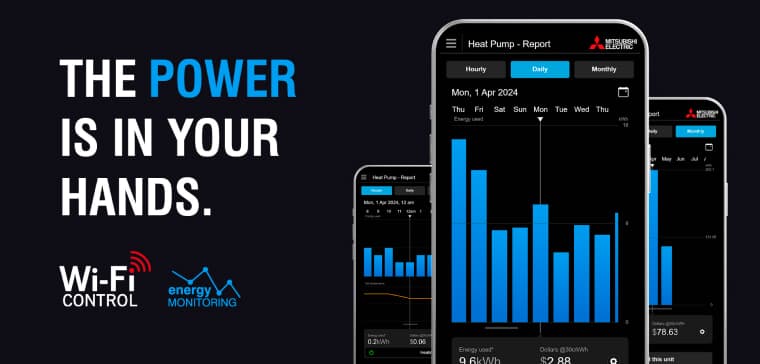
Mitsubishi Electric also highlights energy monitoring for compatible units, giving users visibility over indicative energy use so they can make more informed decisions. That kind of feedback is useful because many households do not realise how long a unit runs, when it is overworking, or how small changes in settings affect comfort and cost.
For landlords and property managers, that visibility can be just as important as the technology itself. It provides a simple way to support better compliance habits, reduce tenant complaints, and keep heating or cooling use consistent across multiple properties.
Compatibility with Heat & Cool products

Heat & Cool’s approach is to pair the right unit with the right controls, rather than treating smart tech as an afterthought. Mitsubishi Electric’s New Zealand Wi-Fi platform is compatible with selected high wall, floor console, ducted, cassette, and ceiling suspended systems, and the company says the Wi-Fi interface can be built in on some models or retrofitted to compatible existing units.
That matters because the best smart heating setup is one that fits the home, not just the brochure. For households wanting discreet control, this may mean a ducted system with app-based zone oversight. For families in a single living area, it may simply mean a compatible high wall unit with remote scheduling, room-temperature visibility, and easier day-to-day operation.
Mitsubishi Electric also states that installation of the Wi-Fi interface should be done by an authorised installer, which aligns with Heat & Cool’s focus on getting the technical side right the first time.
Smart setup example
A practical example helps show why this technology matters. Imagine a family that leaves home at 8:00 am, returns after school pickup, and spends most evenings in the living room. Instead of leaving the heat pump running all day, they can schedule a warm-up shortly before they arrive, then switch to a more economical maintenance setting later in the evening. That is comfort without the waste of heating an empty house.
Now compare that with a property manager handling a rental in Auckland. With remote access, they can confirm a vacant property is not being left on unnecessarily, and they can coordinate settings without needing to be physically on-site. That is where home automation heating becomes more than a nice-to-have. It becomes a management tool.
Step-by-step setup guide
Here is the simplest way to approach WiFi integration with a compatible Mitsubishi Electric heat pump or ventilation system.
1. Confirm model compatibility. Mitsubishi Electric lists compatible domestic high wall, floor console, ducted, cassette, and ceiling suspended systems, as well as selected Lossnay ventilation systems. You can also talk to the team at Heat & Cool who will be happy to advise.
2. Check your router setup. Mitsubishi Electric’s Wi-Fi Control requires a WPA2-AES capable router with a 2.4GHz band enabled, plus an active internet connection.
3. Choose the right interface. Some units have built-in Wi-Fi, while others use an optional Wi-Fi interface or a retrofit module.
4. Arrange authorised installation. The interface should be installed by an authorised installer, which is important for performance, safety, and warranty protection.
5. Download the app. Mitsubishi Electric’s Wi-Fi Control app is available from the New Zealand and Australian Apple App Store or Google Play Store.
6. Pair the unit. You connect the interface to your home network, then add the unit in the app using the device details provided.
7. Set your rules. Once connected, create schedules, minimum and maximum temperature rules, fan preferences, and room-specific operating habits that suit the household.
If your household has children, shift workers, or people sensitive to temperature swings, those minimum and maximum room settings are especially useful because they reduce the need for constant manual adjustment.
Why choose Heat & Cool?
A lot of businesses sell heat pumps. Fewer explain how smart controls change the way the system performs in real homes. That is where Heat & Cool can stand out. Rather than treating the heat pump as a standalone appliance, the smarter approach that we take is to design comfort around occupancy patterns, room use, energy use, and the way the family or tenant actually lives, helping you to get the most out of your system, whilst reducing energy bills and saving you money.
FAQs
Can I add WiFi control to my existing heat pump?
Yes, on some compatible Mitsubishi Electric models the Wi-Fi interface can be retrofitted, while other systems may already have built-in Wi-Fi.
Do I need special internet equipment?
Mitsubishi Electric says you need a compatible WPA2-AES router with 2.4GHz enabled and an active internet connection.
Does WiFi control really save money?
It can, because it helps you avoid leaving the unit on unnecessarily, fine-tune schedules, and better match heating or cooling to actual occupancy. EECA also notes that heat pumps are already among the cheapest heating options over time, so avoiding waste improves the result further.
Is this useful for rental properties?
Yes. Remote control and scheduling can help property managers manage vacant homes, reduce wasted energy, and keep comfort consistent across multiple units.
Can WiFi control be used with ventilation systems too?
Yes. Mitsubishi Electric states that the Wi-Fi interface is available for selected Lossnay ventilation systems as well as compatible heat pumps.
Will smart controls work if I am away from home?
Yes. Mitsubishi Electric says you can control compatible systems through your smartphone, tablet, or online account from anywhere with internet access.
Smart controls are no longer a novelty. For Auckland homes, they are becoming a practical part of better comfort, lower waste, and more responsive living.
Related Posts

Small but Mighty – New Mini Range of Heat Pumps
April 4, 2025
EcoCore AP Mini Series High Wall Heat Pumps NZ's smallest Heat Pump Units New Zealand’s Smallest Heat Pumps Just in time for what is set to be a record breaking, warm summer, the team at Mitsubishi Electric have given us New Zealand’s smallest, most...
READ MORE
Healthy Homes Standards – What you need to do by July 2020
March 21, 2025
The Healthy Homes Standards became law in July 2019 and determine how a rental property should be heated. All private rentals must comply with all healthy homes standards, including the heating standard, within 90 days of any new or renewed tenancy on or after 1 July...
READ MORE
Why Poor Air Quality is a Major Cause of Household Illness and How To Improve It
April 18, 2025
The latest report from the National Institute of Water and Atmospheric research predicts a hotter than average summer! The NIWA issues a seasonal forecast for all of the regions in New Zealand and the latest forecast for the summer period is predicting a long hot...
READ MORE